Fillet Knife: The Complete Guide (How to Pick One + Our Picks)
Try filleting a trout with your chef’s knife. The wide blade refuses to glide under the skin, the stiff edge cuts into the flesh instead of riding along the spine of the fish, and what should have been two clean fillets comes off as a torn, wasteful mess. Half your dinner ends up stuck to the bone.
A fillet knife is the fix. It is long (6 to 9 inches), narrow, and so flexible the blade bends visibly under light pressure. The flex lets it track along the spine of a fish and slide between skin and flesh without slicing into either. The narrow profile cuts cleanly without dragging.
For a home cook who buys whole fish, processes their own catch, or trims their own salmon, a fillet knife pays for itself fast. For someone who only opens a vacuum-packed fillet a few times a year, a sharp chef’s knife will do. The dividing line is the fish.
What a Fillet Knife Is Used For
A fillet knife works on fish, mostly. The thin flexible blade is built around the geometry of removing flesh from a backbone and separating flesh from skin.
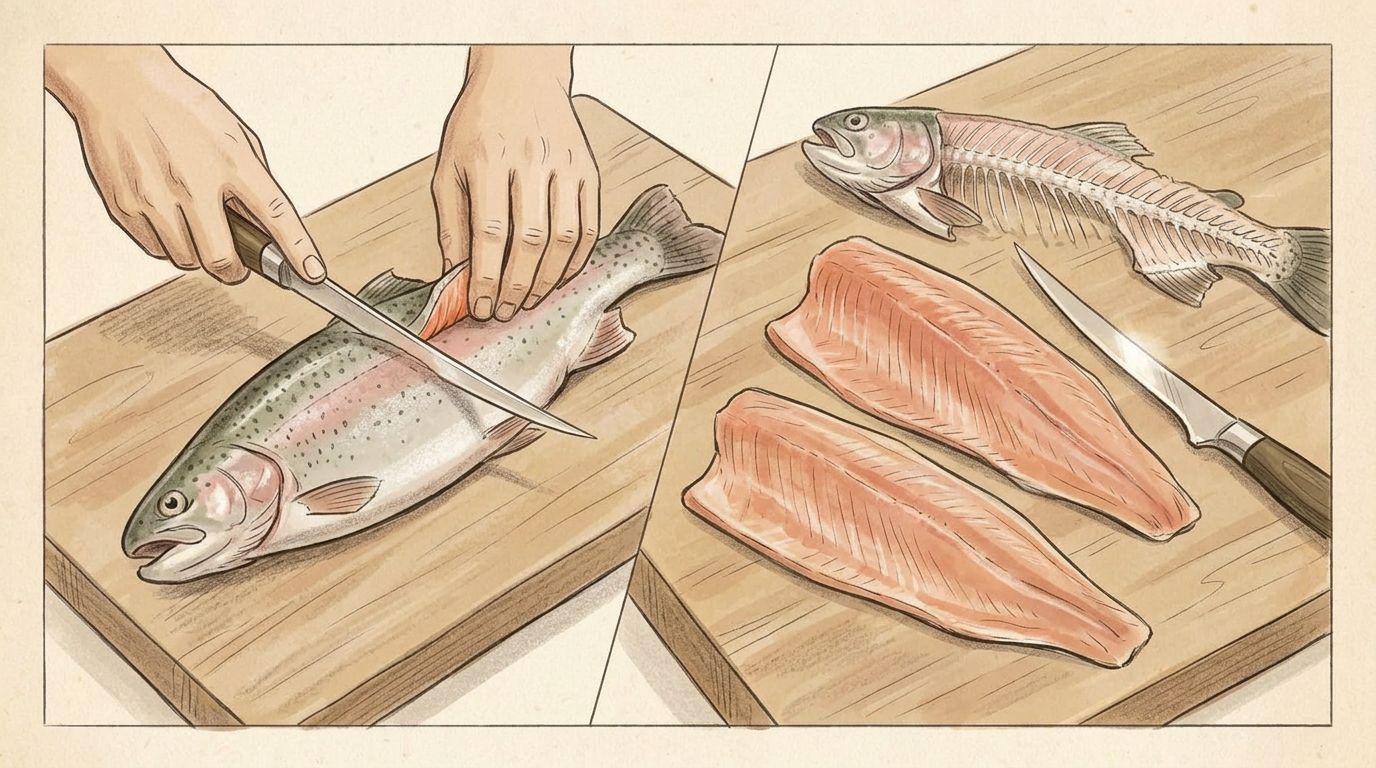
Filleting whole fish. Trout, salmon, walleye, snapper, bass, sea bream. The blade rides along the backbone from gill to tail, lifting one clean fillet off in a single pass, then repeats on the other side.
Skinning fillets. Lay the fillet skin-side-down on the board, pin the tail end with one hand, slip the blade between skin and flesh at a low angle, and pull the skin, not the knife. The flex tracks the curve. The skin comes off in one continuous piece.
Removing pin bones. Run your finger down a salmon or trout fillet, feel each pin bone, then slice along it just deep enough to expose the bone. The thin tip cuts a clean channel without removing the surrounding flesh.
Slicing smoked salmon or gravlax. The long thin blade with light flex produces translucent paper-thin slices when laid almost flat against the side of cured fish.
Carpaccio and crudo prep. Same principle as smoked salmon. Anything where you want a long sweeping cut producing one clean slice.
What a fillet knife is not for: anything with bone you need to push through, anything you would chop or dice, any work where the blade needs leverage. The flex that makes it perfect for fish makes it useless for tough connective tissue. For raw meat with bone, reach for a boning knife.
What Makes a Fillet Knife Different
Three features set a fillet knife apart from every other blade in the drawer.
Length. Most fillet knives are 6 to 9 inches. The standard is 7. The extra length means you can pull through a long fish like a salmon in one continuous stroke instead of sawing.
Flex. The defining feature. A fillet knife bends under light pressure, sometimes dramatically. That flex is what lets the blade follow the curve of a backbone instead of cutting through it, and what lets the blade ride between skin and flesh instead of slicing into either.
Narrow profile. A fillet knife is one of the thinnest blades in the kitchen. The thin spine means less drag against the flesh, less juice squeezed out, and a cleaner cut surface on every pass.
The handle usually matches the wet, slippery work. Synthetic, textured, and grippy when slick is the standard. Wood handles look traditional but are harder to keep sanitary after hours of fish work.
Flex Grades
Not all fillet knives bend the same amount. Three grades dominate.
Full-flex. The blade bends through a wide arc under light pressure. Best for small to medium soft-fleshed fish: trout, walleye, bass, snapper. Most kitchen fillet knives are full-flex.
Semi-flex. The blade bends but with more resistance. Better for larger fish like salmon or grouper where you need a little more authority to push through dense flesh near the head.
Stiff. Almost no flex. This crosses into boning knife territory and is better for very large fish like tuna or for processing fish frames after the main fillets come off. A flexible knife will flex away from what you are trying to cut on these jobs.
If you can only own one fillet knife and you cook a mix of fish at home, a full-flex 7-inch is the right starting point. If you mostly handle salmon or larger species, a semi-flex.
Fillet Knife vs Boning Knife
Easy to confuse. Both are long, narrow, and (sometimes) flexible. The difference comes down to flex and what they are built to handle.
A fillet knife is longer (6 to 9 inches), thinner, and very flexible, almost whippy. It is built specifically for fish: gliding under skin, separating flesh from the spine, removing pin bones.
A boning knife is shorter (5 to 6 inches), thicker, and either stiff or moderately flexible. It is built for all raw protein: chicken, pork, beef, game.
You can use a flexible boning knife to fillet a small fish in a pinch. You should not use a fillet knife on a chicken or pork shoulder. The blade flexes away from the bone when you need it to track along, and the thin profile lacks the leverage that real boning requires.
If you fish more than you butcher, a fillet knife. If you cook more meat than fish, a boning knife. If you do both regularly, one of each.
Kitchen Fillet Knives vs Angler’s Fillet Knives
One more distinction worth flagging. The fillet knife you reach for in the kitchen is not always the same one you reach for on the boat or at the dock.
Kitchen fillet knives are made by Wusthof, Henckels, Mercer, Victorinox, and other cutlery brands. The blade and handle are tuned for a home or restaurant kitchen: clean surfaces, controlled lighting, no salt spray.
Angler’s fillet knives are made by Rapala, Bubba, Marttiini, Dexter Russell, and others. They tend toward grippy synthetic handles, sheaths, and saltwater-grade steel because they live in tackle boxes and get used wet, sandy, and outside.
The blade geometry is similar. The build is different. If you process most of your fish in your kitchen, a cutlery-brand fillet knife is fine. If you fillet at the cleaning station or on the deck, get a knife built for those conditions.
Electric Fillet Knives
Electric fillet knives use two thin serrated blades that move in opposite directions. The motion does the cutting for you, which is useful if you process fish at volume (commercial guides, frequent multi-fish days) or if you have wrist or grip issues that make manual work tiring.
Two trade-offs. First, the serrated blades leave a rougher cut surface than a sharp manual blade in skilled hands. Second, electric models break long before a good manual fillet knife wears out, and they take up more storage than a single blade.
If you keep your knives sharp and you fillet one or two fish at a time, manual gives better results. If you fillet many fish per day or you are processing limits after a long day of fishing, an electric is forgiving and fast. Bubba and Rapala both make widely-used cordless options that anglers swear by.
What to Look for When Buying One
Length: 7 inches for most kitchens. Long enough for salmon and trout, short enough to handle in tight spots. Step up to 9 inches if you process large saltwater fish.
Flex grade: match it to what you process. Full-flex for small to medium fish. Semi-flex for salmon and larger. Stiff if you regularly handle tuna or big saltwater species.
Steel: high-carbon stainless. Fillet knives spend a lot of time wet. A corrosion-resistant high-carbon stainless steel (like the X50CrMoV15 used on European forged blades) handles the moisture well and takes a quick touch-up between sharpenings.
Handle: grippy when wet. This is the single biggest comfort factor. Fibrox, TPE, and other commercial-grade synthetics grip when slick with water, slime, or blood. Wood handles look better and grip worse.
Sharp point. A needle-sharp tip is what starts every cut along the spine of a fish. A blunt tip wastes flesh.
Sheath if you travel with it. A thin flexible blade chips easily without protection. Many angler-oriented fillet knives come with one. Most kitchen-oriented fillet knives do not.
How to Use a Fillet Knife
Three habits cover most home use.
Ride the bones, do not cut through them. The blade rides along the surface of the spine and ribs, scraping flesh away. You never push the edge into a bone. If you hit one, back off and adjust the angle.
Use the tip and the heel for different jobs. The tip starts cuts along the spine and works around the head. The heel slices long passes through the flesh once the fillet is mostly separated.
Anchor the fish. Hold the head or tail steady with your non-knife hand, fingers curled away from the blade. Fillet knives are sharp and flexible and slip more than other kitchen knives. Pay attention.
Skin removal is its own move. Lay the fillet skin-side-down, pin the tail end with one hand, slip the blade in at a low angle just above the skin, and pull the skin (not the knife) toward you while you keep the blade still. The flex tracks the curve. One continuous pull.
Care and Sharpening
Fillet knives need more sharpening attention than chef’s knives because they spend so much time wet and in contact with bone and skin. Plan to hone before each use and sharpen more often than your other kitchen knives.
Hone before each session. A few passes on a steel or ceramic rod realigns the edge. Takes twenty seconds.
Sharpen every three to four months. More often than a chef’s knife. Use a whetstone or pull-through. Our sharpening guide covers both, though the thin flex of a fillet blade requires a light touch on a stone, because pressing hard can flex the blade away from the angle you are trying to hold.
Dry immediately after use. Wet steel pits and rusts fast, even on stainless. Never put a fillet knife in the dishwasher. Repeated heat and moisture cycles are hardest on thin edges, and a fillet knife has one of the thinnest in the kitchen.
Store with the tip protected. A magnetic strip, in-block storage, or a sheath keeps the needle point intact. A loose drawer chips long thin blades in weeks.
Fillet Knives We Recommend
Three picks for three different use cases. All are available at KnifeCenter’s kitchen fillet knife selection.
Best overall: Wusthof Classic 7-Inch Fillet Knife. Forged German steel, full tang, riveted synthetic handle. The 7-inch flexible blade is the right tool for the way most home cooks use a fillet knife: trout, salmon, snapper, bass. Sharp out of the box and the steel takes a hone well between sharpenings.
Best value workhorse: Victorinox Forschner 8-Inch Fibrox Pro Flexible Fillet/Boning Knife. The dual-purpose commercial blade that has lived in pro fish stations for decades. Stamped rather than forged, so it is light, the Fibrox handle grips wet hands the way no wood handle ever will, and it doubles as a passable boning knife in a pinch. Hard to beat at this price.
For anglers and dockside work: Marttiini Basic Fillet Knife. Finnish maker founded in 1928 and best known for its fillet knives. Textured rubber handle for wet grip, included sheath for the tackle box, and a forgiving flex grade. Not the most refined edge in the lineup, but the right tool for the boat or the cleaning table.
Frequently Asked Questions
What is a fillet knife used for?
Removing flesh from fish bones and skin with minimal waste. The long, thin, flexible blade is built for filleting whole fish, skinning fillets, removing pin bones, and slicing smoked salmon or gravlax. It is a fish tool, not a general prep knife.
What size fillet knife is best?
Seven inches for most home cooks. Long enough for salmon and trout, short enough to handle without overshooting on smaller fish. A 6-inch is fine if you mostly process panfish. Step up to 9 inches if you regularly handle large saltwater fish.
Is a fillet knife the same as a boning knife?
No. A fillet knife is longer (6 to 9 inches), thinner, and very flexible. A boning knife is shorter (5 to 6 inches), thicker, and either stiff or moderately flexible.
Fillet knives are designed specifically for fish. Boning knives handle all raw protein. The blades look similar but solve different problems.
Can I use a fillet knife on chicken or pork?
In a pinch on small jobs, yes. The thin flexible blade is too whippy for heavier work though, and a flexible boning knife will handle a chicken much better. Save the fillet knife for fish and a boning knife for poultry and other raw meat.
Do I need an electric fillet knife?
Only if you process fish at volume, or if wrist or grip issues make manual work tiring. For one or two fish at a time, a sharp manual blade gives a cleaner cut surface and lasts longer. For limits after a long fishing day, electric is forgiving and fast.
Do I need a fillet knife if I already own a chef’s knife and a paring knife?
Only if you cook whole fish or fillet your own catch. For pre-broken-down vacuum-packed fillets, a sharp chef’s knife is enough. If you buy whole trout or salmon, or you fish, a fillet knife is the next blade worth adding to the core three.
The Bottom Line
A fillet knife is the specialist knife for fish. Long, thin, and flexible enough to ride along a backbone or under a skin without tearing what you want to keep. A 7-inch full-flex blade with a synthetic handle covers what most home cooks need. A semi-flex blade if you mostly handle salmon and larger fish.
Once you have your essential kitchen knives covered and a way to keep them sharp, a fillet knife is the next blade that earns its drawer space if you cook whole fish at home.