Honing vs Sharpening: What’s the Difference (and Which Do You Need)?
Open most kitchen knife sets and you’ll find a long metal rod tucked into the block. It looks like a sword. The instructions probably called it a “sharpening steel.” It isn’t. That rod is a honing rod, and most home cooks use it wrong, never, or both.
Honing and sharpening sound interchangeable. They’re not. They do different things to the blade, on different schedules, with different tools. Knowing which one you actually need is the difference between a knife that stays sharp for a decade and a knife that goes dull in six months.
The Difference in 30 Seconds
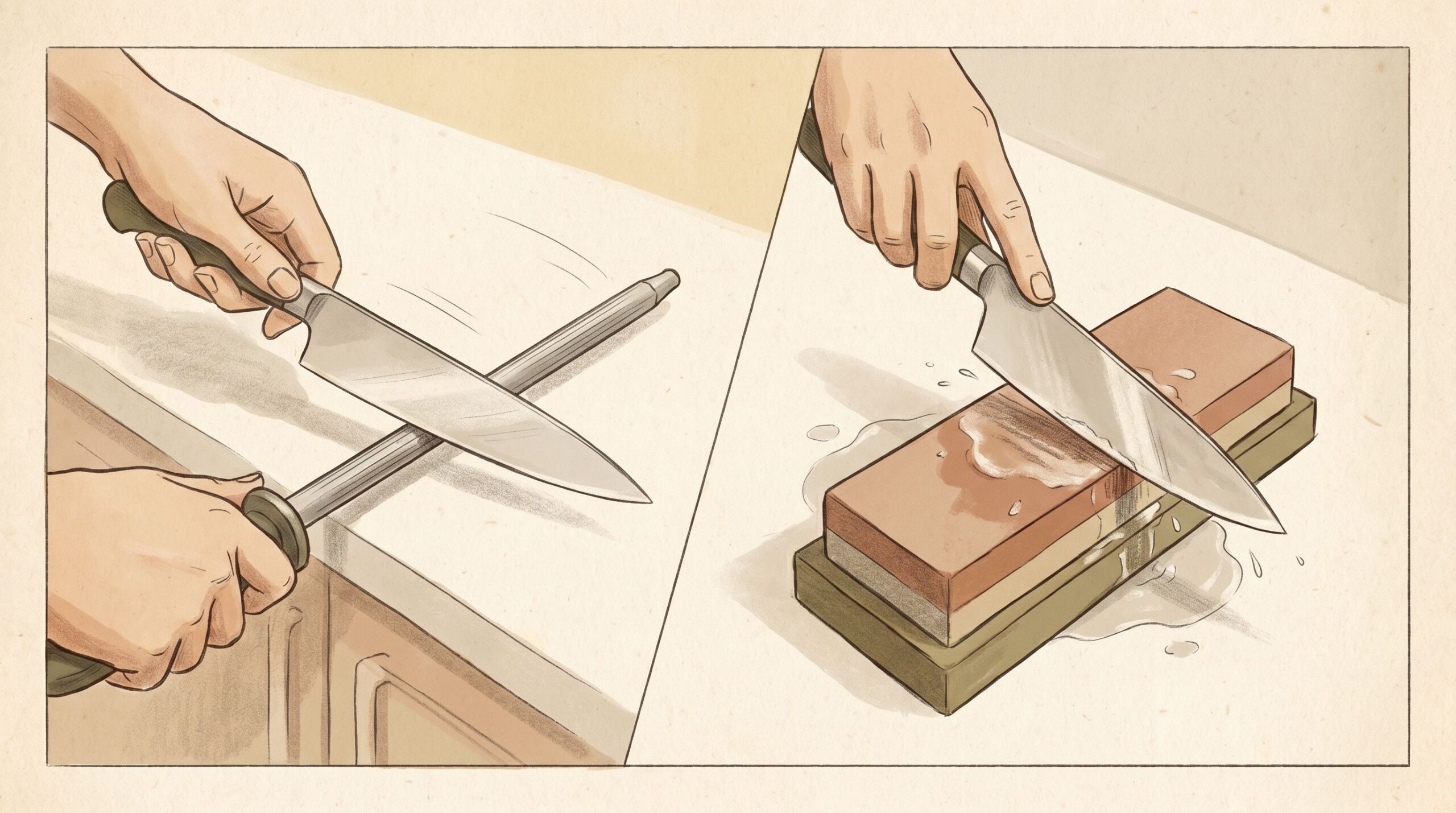
Honing realigns a knife’s edge. It doesn’t remove metal. Use it often, every few cooking sessions or before a big prep. Tool: a honing rod (steel or ceramic).
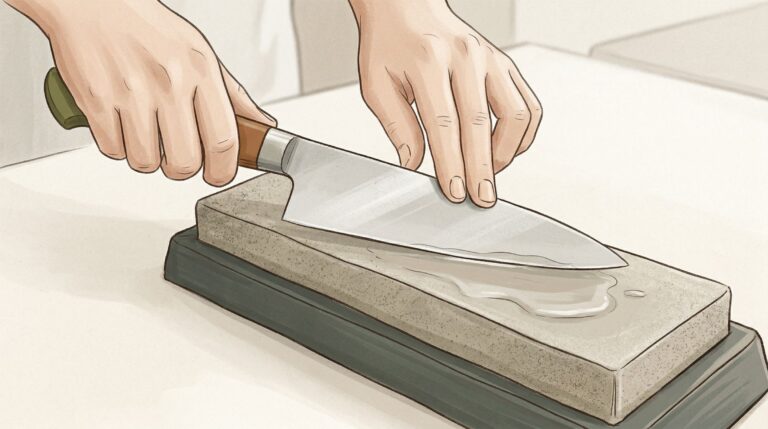
Sharpening grinds metal off the blade to create a new edge. It does remove material. Use it rarely, every few months to a year. Tool: a whetstone, a pull-through sharpener, an electric sharpener, or a diamond rod.
Honing is maintenance. Sharpening is repair. You need both, but you’ll do one ten times more often than the other.
What Honing Actually Does
Every time you cut, the very thin metal at the edge of the blade gets bent. The edge isn’t chipped or worn down, just deflected microscopically to one side. The metal at the edge is so thin it acts like a row of tiny teeth standing upright, and cutting tilts them sideways. That tilt is what makes a “sharp” knife start feeling dull, even when no metal has actually been lost.
A honing rod pushes those bent teeth back upright. The edge is the same width and the same age. It just isn’t aligned anymore, and a honing rod realigns it. That’s why honing can take a knife that feels dull and make it cut like new in 30 seconds.
You’re not adding sharpness. You’re recovering the sharpness that was already there.
This is also why people think their honing rod is sharpening their knife. It feels like it does. But once the edge is genuinely worn (the metal at the tip rounded off, not just bent), no amount of honing will bring it back. That’s when sharpening takes over.
What Sharpening Actually Does
Sharpening grinds metal off both sides of the blade until you’ve ground down to fresh steel and formed a new edge. The tool can be a whetstone, a pull-through sharpener, an electric sharpener, or a diamond rod. The mechanism is different in each (loose grit, ceramic wheels, abrasive belts, bonded diamond particles), but the effect is the same: a fresh edge ground out of the blade.
The result: a brand-new edge a hair thinner than the one you had before. After enough sharpenings (we’re talking many years), the blade narrows enough that you can see it. Most home cooks never reach that point because they sharpen so rarely.
Sharpening is also where technique matters. The angle has to be consistent and matched to the blade. German knives like a 20-degree angle per side. Japanese knives prefer 15. Get the angle wrong and you can damage a knife that just needed a touch-up. Our sharpening guide walks through every method.
When to Hone vs When to Sharpen
This is the part that confuses everyone. The honest answer: hone often, sharpen rarely.
Hone before or during heavy prep. If you’re chopping for a big meal, run the blade down a honing rod a few times before you start. Pros do this constantly. The minute it takes pays back in cleaner cuts and less effort.
Hone every few uses for daily cooking. A weeknight cook can hone once a week and be in great shape. Don’t overthink the cadence. If the knife feels less sharp than it should, hone it.
Sharpen when honing stops working. The classic test: hold a sheet of paper by one edge and slice down through it. A sharp knife glides through cleanly. A dull knife tears or slides off.
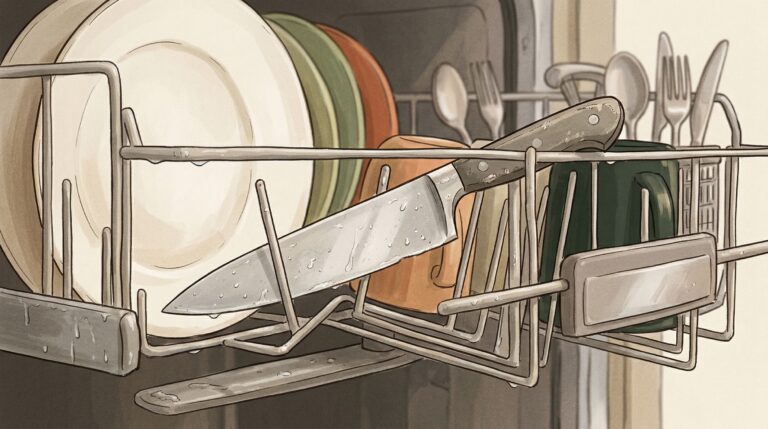
If your knife fails this test even right after honing, it’s time to sharpen. Repeated dishwasher cycles can also damage the edge faster than any honing rod can fix.
Sharpen on visible damage. Chips, nicks, a rolled edge you can feel with a fingernail. Honing won’t fix these. You need to grind down to fresh steel.
For most home cooks, that means honing roughly weekly and sharpening once or twice a year. If you cook every day or have a heavy prep style, sharpen every 3 to 4 months. Light users can stretch sharpening to once a year or longer.
Steel vs Ceramic vs Diamond Rods
The rod that came with your knife block is almost always a steel honing rod. But there are three rod types on the market and they don’t all do the same job.
Steel honing rods. Smooth or fine-grooved hardened steel. Pure honing tools. They realign the edge without removing meaningful amounts of metal. This is what professional kitchens use because they hone constantly and don’t want to wear knives down. Best for daily maintenance on Western knives like Wusthof, Henckels, and Victorinox.
Ceramic honing rods. Glazed ceramic surface. They mostly hone, but they also remove a tiny bit of metal, so they can do light sharpening between full sharpenings. Gentler than diamond and a good middle-ground option, especially for harder Japanese-style knives where steel rods can be too soft to bite.
Diamond rods. Steel core coated in industrial diamond particles. These are technically sharpeners, not honers. They remove metal aggressively and create a fresh edge fast. Useful for restaurant kitchens with high turnover or for putting an edge back on a really dull blade in a hurry. Overkill for daily home use because they wear knives down faster than they need to.
If you only buy one rod, get a steel honing rod. If you own Japanese knives or want one tool that does both light sharpening and honing, get ceramic. Skip the diamond unless you have a specific reason to put a fresh edge on a knife in 30 seconds.
How to Hone a Knife
The technique is simple, and the most common mistake is going too fast and pressing too hard. The point is the angle, not the force. The weight of the knife on the rod is enough.
Set the rod vertical. Place the tip on a non-slip surface like a folded towel on the counter. Hold the handle so the rod is upright in front of you.
Find the angle. Lay the blade against the rod with the heel near the rod’s handle, then tilt it out to about a 15 to 20 degree angle between the blade and the rod. If you picture the blade lying flat against the rod as 0 degrees and pointing straight out as 90, you want it tilted about a fifth of the way up from flat. The exact angle isn’t critical for honing, consistency is.
Pull down and across. In one smooth motion, pull the blade down the rod toward you while sliding it from heel to tip. The whole edge should make contact with the rod by the end of the stroke. Light pressure. The weight of the knife is enough.
Switch sides. Repeat on the other side of the rod. Alternate sides for 6 to 10 strokes total.
Wipe and test. Rinse or wipe the blade. Try the paper test or slice a tomato. If it’s gliding cleanly, you’re done. If it’s still struggling, the knife needs sharpening, not more honing.
Our Honing Rod Picks
Any of these will do the job for years.
Under $20: the budget pick
KitchenIQ by Smiths 9″ Sharpening Steel (~$14)
The cheapest serviceable option. It’s not as refined as the Victorinox, the handle is plastic, and it’s a touch shorter at 9 inches. But it works. If you just want a rod to live in a drawer and pull out once a week, this gets the job done for the price of a sandwich.
$30-$45: the everyday workhorse
Victorinox 10″ Sharpening Steel (~$39)
The pro standard. Magnetized to grab metal shavings, and the Fibrox handle grips well even with wet hands. This is the rod you’ll find in butcher shops and restaurant kitchens because it does the job and costs almost nothing. If you only ever buy one honing rod, this is it.
$60-$75: the upgrade tier
Wusthof 10″ Sharpening Steel (~$65)
Made in Solingen, Germany, in the same factory as Wusthof’s chef knives. Heavier than the Victorinox, with a more substantial feel and better balance for longer prep sessions. If you already use Wusthof Classic knives, this matches the set.
Zwilling J.A. Henckels Twin Four Star 10″ Sharpening Steel (~$60)
Zwilling’s classic German honing rod. Hardened steel surface, contoured handle, well-weighted. The Twin Four Star line is what most Henckels owners reach for, and the rod is the natural pairing.
Shun Premier 9″ Combination Honing Steel (~$60)
The Japanese pick. Designed to work on both Western and harder Japanese-style knives, where a standard soft steel rod can struggle to grip the edge. The polished stainless handle is unusually attractive for a tool that lives in the knife block. A natural pairing if you already own Shun chef knives.
The diamond alternative
DMT 10″ Diamond Steel (Fine) (~$40)
Not a true honing rod. This is a diamond sharpener that looks like one. Use it when you want to put a fresh edge on a knife fast without pulling out a whetstone.
Probably not your daily-driver rod, but a great backup for when honing isn’t bringing the edge back. Use it sparingly, since each pass removes more metal than a steel or ceramic rod.
The rod barely matters. The habit does. A $14 steel rod used weekly will keep your knives sharper than a $150 premium rod that lives untouched in the block.
Frequently Asked Questions
Is honing the same as sharpening?
No. Honing realigns a bent edge without removing metal. Sharpening grinds metal off the blade to create a new edge. Both are necessary, but on very different schedules. You’ll hone roughly weekly and sharpen once or twice a year.
Why is my honing rod called a sharpening steel?
The names blurred together over decades. Most manufacturers still print “sharpening steel” on the packaging because that’s the historical term, even though the tool is technically a honing rod. The takeaway: the rod that came with your knife block does not actually sharpen. You also need a real sharpener.
How often should I hone my kitchen knife?
For weeknight home cooking, once a week is plenty. If you do heavy prep or cook every day, hone before each long session. Pros hone constantly because they cut all day. There’s no harm in honing more often, just less benefit.
How often should I sharpen my kitchen knife?
Most home cooks should sharpen once or twice a year. Heavy daily users every 3 to 4 months. The honest test: when honing no longer brings the edge back and the knife fails the paper test, it’s time. Don’t sharpen on a fixed schedule, sharpen when the knife asks for it.
Can a honing rod sharpen a really dull knife?
No. A honing rod can only realign an edge that’s still mostly intact. Once a knife is genuinely worn (the metal rounded over, not just deflected), honing accomplishes nothing. You need a whetstone, electric sharpener, pull-through sharpener, diamond rod, or a professional sharpening service.
Steel or ceramic honing rod, which should I get?
Steel for Western knives like Wusthof, Henckels, Victorinox, and most German-style chef knives. Ceramic for harder Japanese knives like Shun, Tojiro, or Global. If you have a mixed knife block, ceramic is the safer all-rounder because it works on both. If you only own Western knives, steel is the more traditional choice.
Can you hone a serrated knife?
Not with a standard honing rod. The teeth on a serrated knife have to be touched up individually with a tapered ceramic or diamond rod that fits inside each scallop. The good news: serrated edges stay sharp for years and rarely need it.
Does a honing rod wear out?
Eventually, but slowly. A quality steel honing rod can last 20+ years of regular home use. Ceramic rods can chip if dropped on a hard surface and gradually polish smooth, which is when they stop biting the edge. Diamond rods lose their abrasive coating over many years and need replacement when they stop cutting.